

The concept of lifestyle medicine—using evidence-based lifestyle interventions such as nutrition, exercise, sleep, and stress management to prevent and reverse chronic disease—has quietly evolved from a niche idea to a recognized medical discipline. A look at PubMed publication trends reveals a remarkable trajectory.
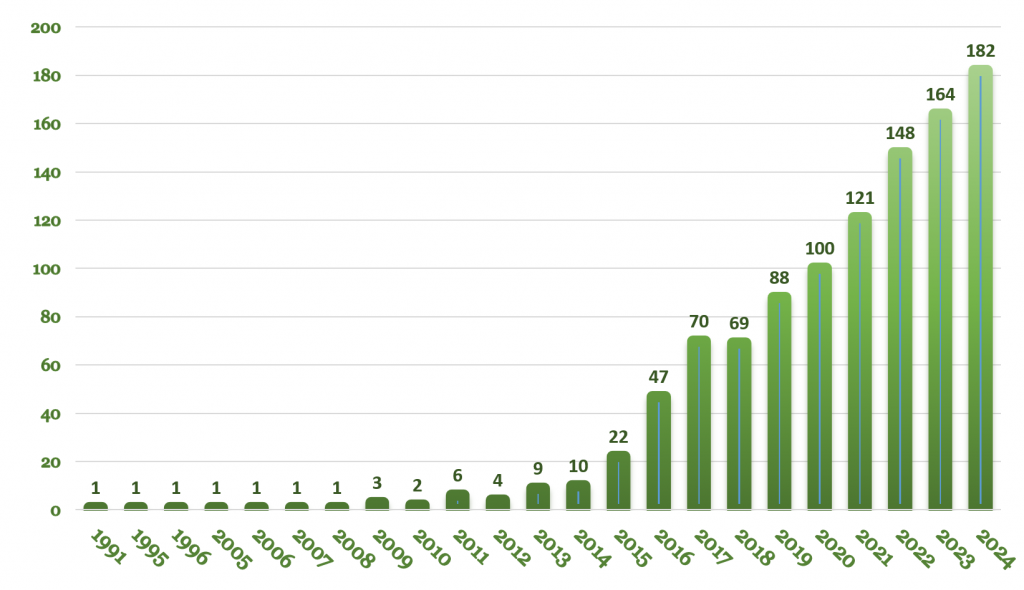
Between 1991 and 2010, publications mentioning “lifestyle medicine” were almost nonexistent, rarely exceeding one or two per year. This period represents the field’s conceptual incubation, when scattered discussions about “healthy lifestyles” began appearing in clinical contexts.
However, the landscape began to shift in the mid-2010s. From 22 papers in 2015 to 69 in 2018 and 121 by 2021, the field showed exponential growth. The most striking acceleration occurred after 2020—an inflection point that may reflect the pandemic’s impact on health consciousness and the growing scientific recognition that chronic disease vulnerability is closely tied to lifestyle factors.
Historical emergence of the term
While the practices underlying what we now call lifestyle medicine (diet, exercise, smoking cessation, sleep hygiene) have long roots (for example health promotion in the Hippocratic tradition), the formal term “lifestyle medicine” appears to have been used in a symposium title in 1989 and appeared as the title of a published article in 1990.
One of the early reviews declares:
The term “lifestyle medicine” was first used in as a title of a symposium in 1989 … it first appeared in publication as a title of an article in 1990.
The Advent of Lifestyle Medicine. Yeh BI, Kong ID. J Lifestyle Med. 2013 Mar;3(1):1-8. Epub 2013 Mar 31. PMID: 26064831; PMCID: PMC4390753.
Moreover, the first textbook explicitly using the term “Lifestyle Medicine” appeared in 1999 (edited by James M. Rippe) and helped anchor the field’s nomenclature.

I would say that LM appeared from The North Karelia Project in 1972 Due to high incidence of cardiovascular diseases, the following advice was given to the population: – use low-fat milk, non-fat milk or sour milk instead of high-fat or whole milk – use other low-fat dairy products instead of high-fat products – cut down the amount of butter or margarine on bread and change to soft margarine or soft butter (mixture of butter and oil) – cut off visible fat in meat, choose lean meat and sausages, and prefer fish and poultry – prepare food without adding extra (animal) fat, in cooking prefer boiling and baking – use vegetable oil in salad dressing and when baking – restrict the use of eggs (egg yolk) to only a couple per week – increase intake of whole-grain cereals – increase consumption of vegetables, roots, berries and fruits To reduce blood pressure levels in a whole population, a special Salt Project was initiated. And measures against smoking were performed They achieved great results (unfortunateley I can’t add picture here), so I will cite: Coronary mortality before the North Karelia Project was about 690 per 100,000 men aged 35–64 in North Karelia. In all Finland it was 470. Mortality reduced faster in the beginning in North Karelia than in all Finland, but after that the development has been quite similar. In 2011 the mortality among middle age men was about 100 per 100,000 and North Karelia had reached the national average. [Vartiainen E. The North Karelia Project: Cardiovascular disease prevention in Finland. Glob Cardiol Sci Pract. 2018 Jun 30;2018(2):13. doi: 10.21542/gcsp.2018.13. PMID: 30083543; PMCID: PMC6062761]